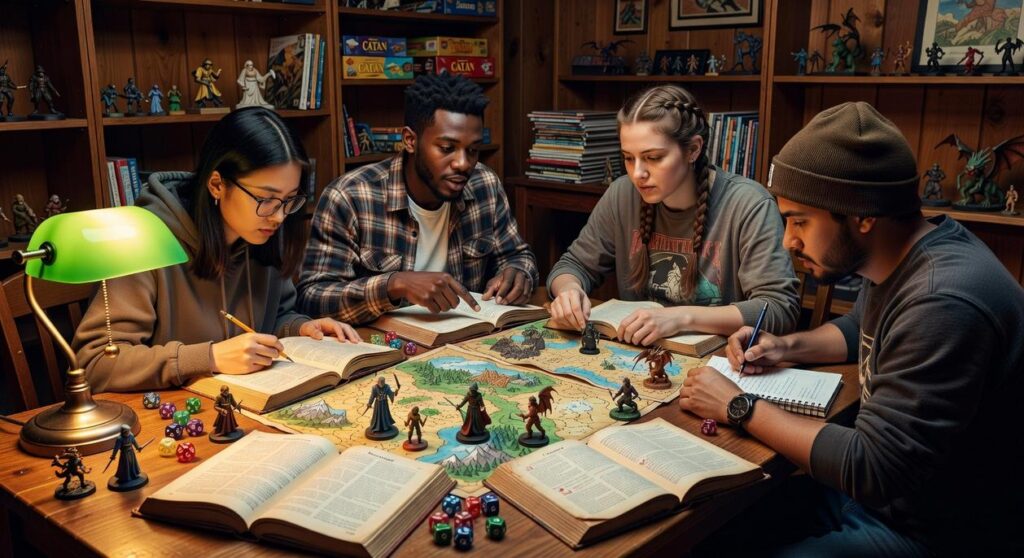

Ever had that heart-pounding moment in ‘Alien: Isolation’ when a creature outsmarts you? Or in ‘The Last of Us’ when an enemy doesn’t just wander aimlessly but actually predicts your next move? That’s not magic; it’s AI game design.
It’s the hidden genius making your gaming experiences both thrilling and, let’s face it, occasionally infuriating. I’m here to peel back the curtain on this mysterious code wizardry.
You’ll discover the secret sauce behind those brilliant enemies and expansive worlds. After deep diving into game mechanics and competitive meta-analysis, I can tell you understanding AI is key to nailing that win.
Stick around, and by the end, you’ll respect the digital brains behind your games but also laugh at their sometimes hilariously dumb decisions. Ready to appreciate the art of gaming AI?
More Than Just ‘Follow the Player’: Game AI Unpacked
When we talk about AI game design, we’re not discussing some all-knowing robot overlord. It’s more like a toolbox. Game AI consists of rules and systems allowing non-player characters (NPCs) and worlds to react and make decisions.
Think of it as a set of tricks, not unlike a movie stunt team, where each member knows their role perfectly.
Ever notice how some bosses in games are just repetitive? That’s a heavily ‘scripted’ event: they stick to a script like an actor who can’t improvise. Meanwhile, changing AI is like the enemy who won’t just stand there politely waiting for you to shoot.
It seeks cover or tries to flank you (smart, right?).
Many folks think game AI is a single, super-intelligent “brain.” It’s not. It’s really a collection of techniques (pathfinding,) finite state machines, behavior trees. Imagine a chess grandmaster.
Now forget that. Game AI is more like a well-trained stunt team creating a smooth illusion.
If you’re curious about where gaming is heading, check out the rise of cross platform play 2023. It’s an exciting time as these design techniques evolve!
The Unseen Puppeteers: AI’s Hidden Hand
Smarter, Scarier Enemies
Ever felt like the game’s outsmarting you? That’s because it probably is, thanks to AI. Take the Vex in “Destiny.” These guys don’t just wander aimlessly.
They use coordinated pack tactics to pounce on you when you’re least prepared. Or remember Nemesis in “Resident Evil 3”? That monster genuinely seems to hunt you.
It’s not random. It’s AI playing the puppet master, making you both the hero and the prey. Do you ever get the feeling that the game knows exactly how to get under your skin?
Worlds That Build Themselves
Procedural content generation, or PCG, is reshaping how we explore virtual worlds. It’s like magic (but really it’s just smart algorithms). Games like “No Man’s Sky” or “Minecraft” take this to the next level.
They’re practically infinite. Each time you load up, you’re greeted with a new world, a new set of challenges. It’s AI doing its thing (creating) worlds where no two playthroughs are ever the same.
You might ask, how does it make every experience unique? Well, that’s the beauty of ai game design. It’s not just random; it’s curated chaos.
The Game That Fights Back
Ever noticed a game getting tougher just when you’re feeling cocky? That’s changing difficulty adjustment at work. “Left 4 Dead” uses an “AI Director” to tweak the game as you play. If you’re breezing through, expect tougher zombies.
Struggling? It might ease up a bit. It keeps you on your toes, ensuring the experience is challenging but fair.
And let’s be honest, it’s fun to pretend you’re in an action movie where the stakes keep rising. Isn’t that why we play games in the first place? To be challenged, to be surprised, and to feel like the hero against unbeatable odds?
From Pac-Man’s Ghosts to Clickers: AI Evolution in Games
Remember when Pac-Man’s ghosts ruled the arcade? That was AI in its infancy. Blinky chasing you like a constant ex?
Pure genius for its time. Each ghost had a simple pattern. Predictable, yet still managed to gobble quarters like candy.
Fast forward to 1998. Enter Half-Life. Suddenly, marines weren’t just cannon fodder.
They flanked, they tossed grenades, they made you sweat. This was AI game design growing up.
But here’s where things get wild. The Last of Us. Those Clickers? Terrifying.
They use sound, not sight, to hunt you down. And don’t even get me started on the human enemies. They talk, they strategize, they react when their buddy bites the dust.
It feels almost personal. It’s like stepping into a living, breathing world where every move you make has consequences.
So, why does this matter? We’re on the brink of something big. As AI in games gets smarter, the experiences become richer, more immersive.
Imagine the virtual reality future immersive games where AI adapts in real-time. It’s not a distant dream. It’s happening now.
The evolution from simple patterns to complex systems is astounding. Each leap forward brings us closer to games that feel almost alive. It’s an exciting time to be a gamer, and I can’t wait to see what’s next.
When the Code Breaks: Hilarious & Infamous AI Fails
Ah, AI game design. It’s a wild ride. We all know AI isn’t perfect, and that’s half the fun.
Remember those “Skyrim” giants? They could launch you into orbit with a single swing. It’s legendary.
I mean, who hasn’t laughed at a guard stuck endlessly against a wall? It’s like watching a cat chase its tail.
These glitches? They’re part of gaming lore. They’re the stories we tell when we’re gathered around, controllers in hand.
And let’s be honest, who doesn’t secretly love finding that sweet spot where a boss can’t reach you because its pathfinding is having a meltdown? Outsmarting AI feels like a tiny victory (even if it’s cheating).
But these funny moments remind us of something bigger. Creating believable AI is complex. It’s like trying to teach a toddler calculus.
So when it works flawlessly, we should really appreciate the effort behind it. Not that we don’t enjoy a good AI fail (those) make the victories even sweeter.
Pro tip: Next time you encounter a glitch, don’t get frustrated. Just think of it as part of the charm. After all, without these quirks, gaming would be a lot less entertaining.
Generative AI: The Next Level for Games
AI game design is about to get a whole lot more interesting. Imagine a game where NPCs (non-player characters, for the uninitiated) aren’t just spitting out the same tired lines. Instead, they’re chatting with you using unique dialogue that reacts to your every question.
Quests could pop up dynamically, crafted on the fly, keeping you on your toes. This isn’t sci-fi anymore. It’s on the horizon, though still in its early stages.
But let’s not get carried away; this isn’t magic. With tech advancing rapidly, the potential for truly changing and unpredictable game worlds is huge. Excited yet?
The Unseen Force in Gaming
Understanding AI game design changes everything. You’re no longer just pressing buttons. You’re seeing the magic behind enemy tactics and those vast, sprawling galaxies.
It’s not just about playing; it’s about appreciating the intelligence driving your favorite games. Remember when you wondered how games felt so alive? That’s the power of AI, silently shaping every experience.
So, what’s the most brilliant (or hilariously dumb) AI moment you’ve seen in a game? Drop a comment below and share your story. Let’s uncover the hidden genius (or madness) of gaming AI together.
Don’t just play (understand.)

 Ask Eddie Sanfordstirs how they got into multiplayer arena strategies and you'll probably get a longer answer than you expected. The short version: Eddie started doing it, got genuinely hooked, and at some point realized they had accumulated enough hard-won knowledge that it would be a waste not to share it. So they started writing.
What makes Eddie worth reading is that they skips the obvious stuff. Nobody needs another surface-level take on Multiplayer Arena Strategies, Controman Competitive Meta Analysis, Hot Topics in Gaming. What readers actually want is the nuance — the part that only becomes clear after you've made a few mistakes and figured out why. That's the territory Eddie operates in. The writing is direct, occasionally blunt, and always built around what's actually true rather than what sounds good in an article. They has little patience for filler, which means they's pieces tend to be denser with real information than the average post on the same subject.
Eddie doesn't write to impress anyone. They writes because they has things to say that they genuinely thinks people should hear. That motivation — basic as it sounds — produces something noticeably different from content written for clicks or word count. Readers pick up on it. The comments on Eddie's work tend to reflect that.
Ask Eddie Sanfordstirs how they got into multiplayer arena strategies and you'll probably get a longer answer than you expected. The short version: Eddie started doing it, got genuinely hooked, and at some point realized they had accumulated enough hard-won knowledge that it would be a waste not to share it. So they started writing.
What makes Eddie worth reading is that they skips the obvious stuff. Nobody needs another surface-level take on Multiplayer Arena Strategies, Controman Competitive Meta Analysis, Hot Topics in Gaming. What readers actually want is the nuance — the part that only becomes clear after you've made a few mistakes and figured out why. That's the territory Eddie operates in. The writing is direct, occasionally blunt, and always built around what's actually true rather than what sounds good in an article. They has little patience for filler, which means they's pieces tend to be denser with real information than the average post on the same subject.
Eddie doesn't write to impress anyone. They writes because they has things to say that they genuinely thinks people should hear. That motivation — basic as it sounds — produces something noticeably different from content written for clicks or word count. Readers pick up on it. The comments on Eddie's work tend to reflect that.